

Vape caps
Store rules get 1st ok
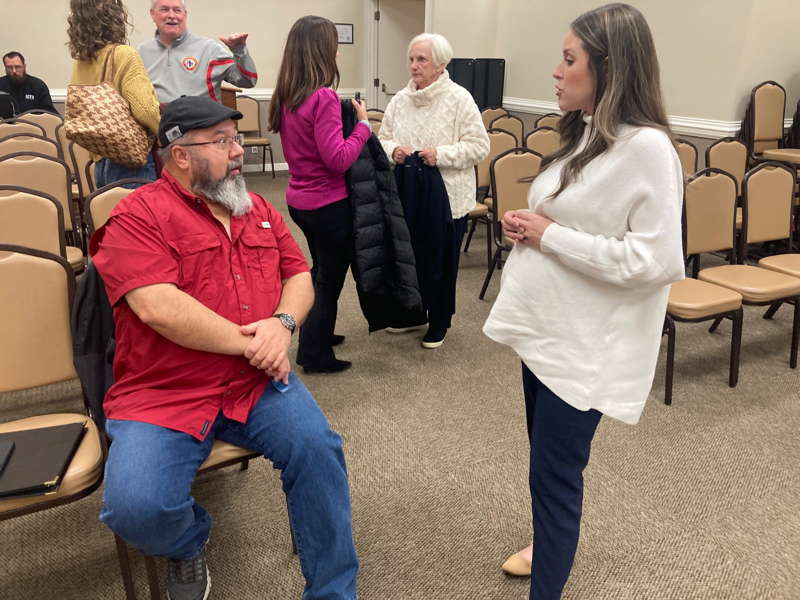
Fred Richmond, co-owner of Tennessee Vapor Factory at 845 Clinch Ave., talks to Shayla Wilson, executive director of Allies for Substance Abuse Prevention of Anderson County. (photo:Ben Pounds )
The Clinton City Council approved the measure on first reading during its Monday, Feb. 23, meeting.
Council member Matt Foster cast the lone dissenting vote, and Brian Hatmaker was absent.
Council members Wendy Maness, David Queener, Rob Herrell, Vice Mayor Larry Gann and Mayor Scott Burton approved the ordinance with the regulations.
It will, however, have to pass a second reading in March to go into effect.
Burton said that will be at the council’s March 23 meeting.
The measure would allow for only three such shops per 10,000 residents.
It defines them as stores dedicating 25% or more of their floor space to “electronic cigarettes/vaping devices, E-liquids/cartridges, edibles, concentrates, or oil containing cannabis derivatives (including but not limited to CBD, Delta-8, Delta-9 or similar compounds permitted by law), Kratom, glassware, pipes, vaporizers and other smoking or inhalation devices.”
Shops also have to be at least 1,000 feet from other similar shops, and at least 500 feet from day-cares, public or private schools, or public parks.
While these rules would not immediately affect the current eight stores that fit that description in Clinton, it would, if passed, apply to any new stores. If existing stores change their layouts for six months to no longer have 25% or more space dedicated to the vape or cannabis products, they, too would have to follow the new regulations if they switched back to more than 25%.
Clinton resident Shayla Wilson, executive director of Allies for Substance Abuse Prevention of Anderson County, brought the issue to the City Council’s attention at an earlier meeting.
Council Member Maness, who also works as ASAP’s youth prevention coordinator, said she’d gotten complaints that the city had too many vape shops.
“I have counted the vape stores down Charles Seivers,” Maness said. “There’s six within a mile, and that’s a lot.”
Fred Richmond, co-owner of Tennessee Vapor Factory at 845 Clinch Ave., told the council at the Feb. 23 meeting, however, that he had concerns about the resolution punishing existing stores like his if they decide to move.
“Would I have to start at the bottom of the list again?” he asked. “That is something that a business owner should not have to worry about –is the city working against them,” he told The Courier News.
Richmond also said that nationwide violations of vape sale regulations more often involve gas stations, Dollar General and Walgreens than specialty vape shops.
Burton told The Courier News after the meeting that the council might look at issues involving existing stores and whether they’d have to go “to the back of the line” if they need to move.
Richmond, while saying he was OK with limiting the number of stores, also argued for his store’s value. He explained that vape products helped people quit smoking. He said he’d previously been a two-packs-a-day smoker, but vaping had helped him quit, and he no longer even vapes any more.
“I am a success story,” he said. He added that his store does not sell cannabis products.
He also said new state regulations will likely limit their success and locations even without the city’s regulations.
“I own a store that only deals in tobacco harm reduction,” he said, adding that the Royal College of Physicians in Britain did a study showing vaping was 95% safer than smoking combustible cigarettes.
“I would like to get all the people in Clinton that smoke to vape rather than smoke,” he said.
Wilson stressed the dangers of nicotine vaping. She said the article Richmond cited was from 2015 and outdated.
“Less harmful doesn’t mean harmless,” she said, adding that vapor products were still addictive, could still cause lung diseases and still included harmful products like formaldehyde. She said they could change brain chemistry and weren’t FDA approved as an addiction-treatment method.
Wilson said the regulations are not intended to affect existing stores, but to address underage use and create a framework for accountability.
“Most of the points that she made were scare tactics that have been used by organizations like hers since the beginning of vaping,” Richmond told The Courier News after the meeting.
“Anything that you burn at high enough temperature creates formaldehydes,” he said.