
County Commission backs New River rails-to-trails effort
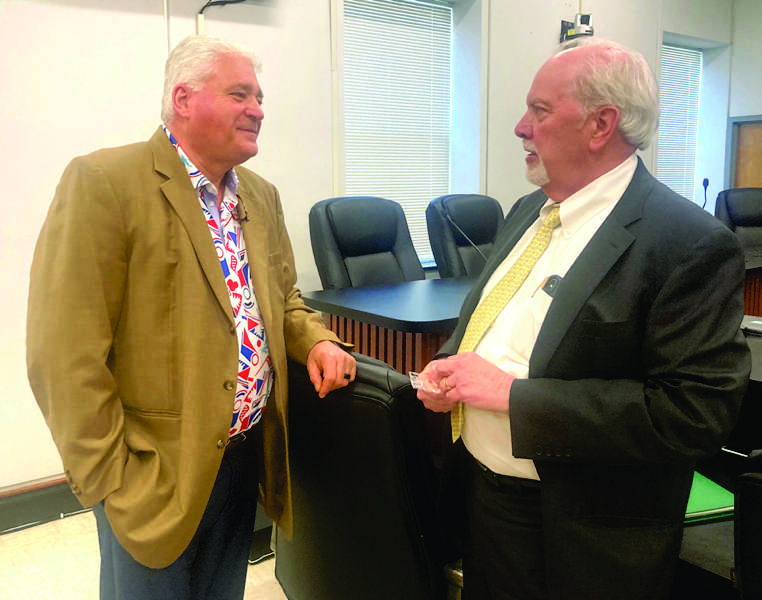
Anderson County Commissioner Tracy Wandell talks to county law director James Brooks after the May 9 Operations Committee meeting. During that meeting, Wandell and other commissioners on the committee voted to send a resolution supporting but not offering funding for a project to convert a former rail line into trails in the county’s New River area. Brooks revised the language before it went to the full commission meeting May 18, during which it passed. (photo:Ben Pounds )
The future trail would follow the abandoned railroad line from Oneida in Scott County to the Devonia community in Anderson County. It is a private project spearheaded by nonprofits rather than county government.
The former Tennessee Railroad, a 42-mile spur off the Cincinnati-Southern mainline in Oneida (operated by Norfolk Southern) has been abandoned by its current owner, the R.J. Corman Railroad of Nicholasville, Kentucky.
Anderson County Mayor Terry Frank beginning in 2020 led a failed effort to save the historic line, which was started in the late 19th century to haul timber and coal out of rural Anderson County.
Owned by Norfolk Southern Corp. (formerly The Southern Railway) from 1973 until Knoxville-based National Coal Corp. bought it in 2006 for $2 million, the line was begun in 1889 and extended to its current terminus at a now-abandoned coal preparation plant at Devonia in 1912. In 2013, R.J. Corman purchased the line.
The Anderson County Commission, at its May 18 meeting, unanimously passed a resolution offering support and encouraging grants and donations from others. The resolution explicitly does not offer any county funding.
It also encourages other New River area improvements, such as water infrastructure, better emergency response and a ZIP code, but does not offer funding for those improvements.
Several residents and commissioners said the trail would provide exercise and activity for the New River community, as well as jobs in bicycle shops.
Commissioner Michael Foster made the motion, and Commissioner Chad McNabb seconded it. Commissioners Ebony Capshaw and Steven Verran were not present.
Nancy Manning, an Oak Ridge resident and executive director of Tennessee Citizens for Wilderness Planning, has promoted the project and spoke about its status to commissioners at the May 18 meeting. She said Trust for Public Land has been negotiating to acquire the railroad land from current owner R.J. Corman. The trail land would then go to a different group called Echoes.
Manning said the commission should encourage private, federal and state grants and donors to move the project forward. Providers of those grants, she said, want to see “visible, local support.”
The project has faced criticism from some New River residents, including Scotty Phillips, owner of the New River General Store that sits along the line, who sent a letter that Commissioner Tim Isbel read at the May 11 Operations Committee meeting. Phillips described the trail as an intrusion by outsiders into the community.
“We’ve all had peace and security here,” he wrote, describing the current order he said the trail would upset by bringing in outsiders who would use it to “line their pockets.”
Ironically, Phillips briefly operated a tourist train along the line until R.J. Corman shut it down after acquiring the rail line.
The engine and passenger cars of Phillips’ train remain parked in the area near Devonia where the rail line ended, with no way to be removed since R.J. Corman pulled up the tracks.
Residents who spoke in person at the May 18 County Commission meeting, including people who currently live in the New River area or had lived there in the past, described the trail as having positive effects for residents.
New River resident Loretta Webber described herself as originally opposed to the project, but said talking to Manning had changed her mind. She said she believed local children would enjoy riding bikes there and could find work at bike shops.
“We need it,” she said. “We’re a dying town, and without you all’s help we’re going to be a dying town.”
Another New River resident, James Burge, who spoke to both the Operations Committee and the full commission, similarly said he had opposed the project but now wanted to work with Echoes to represent the community on the Echoes board. He said the trail could provide jobs and exercise.
“Everybody knows that we’re a community that’s on life support and it needs something to happen,” he said.
But Burge said he wants to help local residents who have concerns.
“I want to look out, to the best of my ability, for those that believe they’ll be invaded,” he said.
Burge told The Courier News that he might support moving the trail away from directly following the rail line to make it less disruptive to adjacent homeowners.
Mike Harris, who grew up in the New River area, attended its former Rosedale School and still owns property in the area, said residents in the past depended on natural resources such as lumber and coal. The remaining natural resource, he said, is natural beauty.
“We have one resource that will never be used up,” he said. “We have the same beauty as Great Smoky Mountains and Frozen Head State Park.”
“We hope this resolution just restores some of the basic necessities this community’s been stripped of,” Isbel said.
Commissioner Shain Vowell warned Echoes that the group needs to take New River area residents’ concerns into consideration.
“If you make a friend from New River, you make a friend for life,” he said. “If you make an enemy from New River, you make an enemy for life.”