
Development board pitches $25K vision project
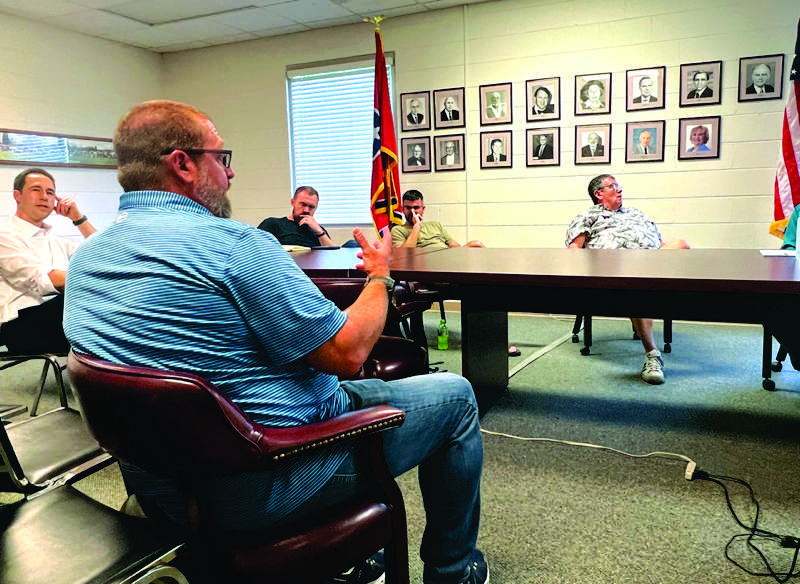
Norris City Councilman Travis Honeycutt, back to camera, who also serves on the Community Development Board, speaks during a board meeting last Thursday at the Norris Community Building. (photo:G. Chambers Williams III )
Members of the board — who are all appointed by the City Council — presented the board’s preliminary ideas for the document at last month’s City Council meeting.
The council took no action on it, even though the city is in the process of finalizing its budget for the fiscal year beginning July 1.
The board met some skepticism from the council over the idea, which some members suggested might turn out to be more of an action plan than just a vision statement.
Last Thursday night (May 28), the Community Development Board met and discussed at length how it might present the idea to the council again, being careful, as several members suggested, that the word “plan” not be used when seeking the $25,000 for the consultant.
They said the idea would be to hire a consultant who would hold “workshop” meetings open to the citizens of Norris to get ideas for a development strategy.
A point of contention, particularly at the May council meeting, seemed to be about whether the board members were proposing a “vision” that includes what private landowners might be able to do — or not do — with their properties. Specifically mentioned was the privately owned Norris Town Center that previously housed Archer’s Market.
At the May 11 council meeting, and again during the development board’s meeting Thursday, several people attempted to make it clear that any vision statement must be limited to city-owned property, not private property.
Mayor Chris Mitchell, who has not publicly endorsed the Community Development Board’s proposal to spend money for the “vision,” held his own meeting recently to present a strategic vision he prepared, giving his own ideas about what the city needs moving forward.
In his statement, Mitchell said that Norris should be a safe, livable community for its residents, with leadership that helps promote a good quality of life.
He presented his “vision” to City Council members and residents during a presentation preceding the Feb. 9 regular council meeting.
He noted up front that he was presenting a “vision,” rather than a plan, and that plans to implement his vision could be rolled out in stages.
Mitchell, who has been mayor for nearly 18 years, spoke at length about Norris’ sidewalks, saying that “We want a walkable community,” and suggesting that a top priority of a strategic plan should be to make sidewalks available throughout the city, and that those already in place should be better maintained.
“I will be calling for a formal plan for sidewalks,” he said.
Residents “should not have to drive home and dodge people in the road,” Mitchell said. “We should provide a safe usage of public lands.”
The mayor also said that Norris does not need to be an “elite” city.
“It needs [to be a place] where anybody can live,” he said. “We need a non-discriminatory community, making people feel welcome and accepted. It does not need to be elite.”
He also stressed keeping the city affordable in regard to taxes and utilities.
In his printed vision statement, Mitchell said the city should “maintain levels of property tax, utility rates and debt to support city budgets without overburdening citizens and businesses.”
In his presentation, he told those in attendance at the meeting: “I will support a property-tax rate increase when I see a need for it.
“At this time, I don’t see it.”
He also said that the city should embrace its history while moving forward. Norris was founded by the Tennessee Valley Authority in the early 1930s, originally meant to house engineers and workers building the nearby Norris Dam.
“We need to respect the past, but we need to evolve,” the mayor said.
Businesses and business development should also be prioritized, he said.
“We have a variety of businesses, and we need to support them.”
The mayor emphasized providing recreational opportunities for residents, which would “evolve as culture changes.”